AI Search Optimization for WordPress: How to Get Your Site Ready for AI Search
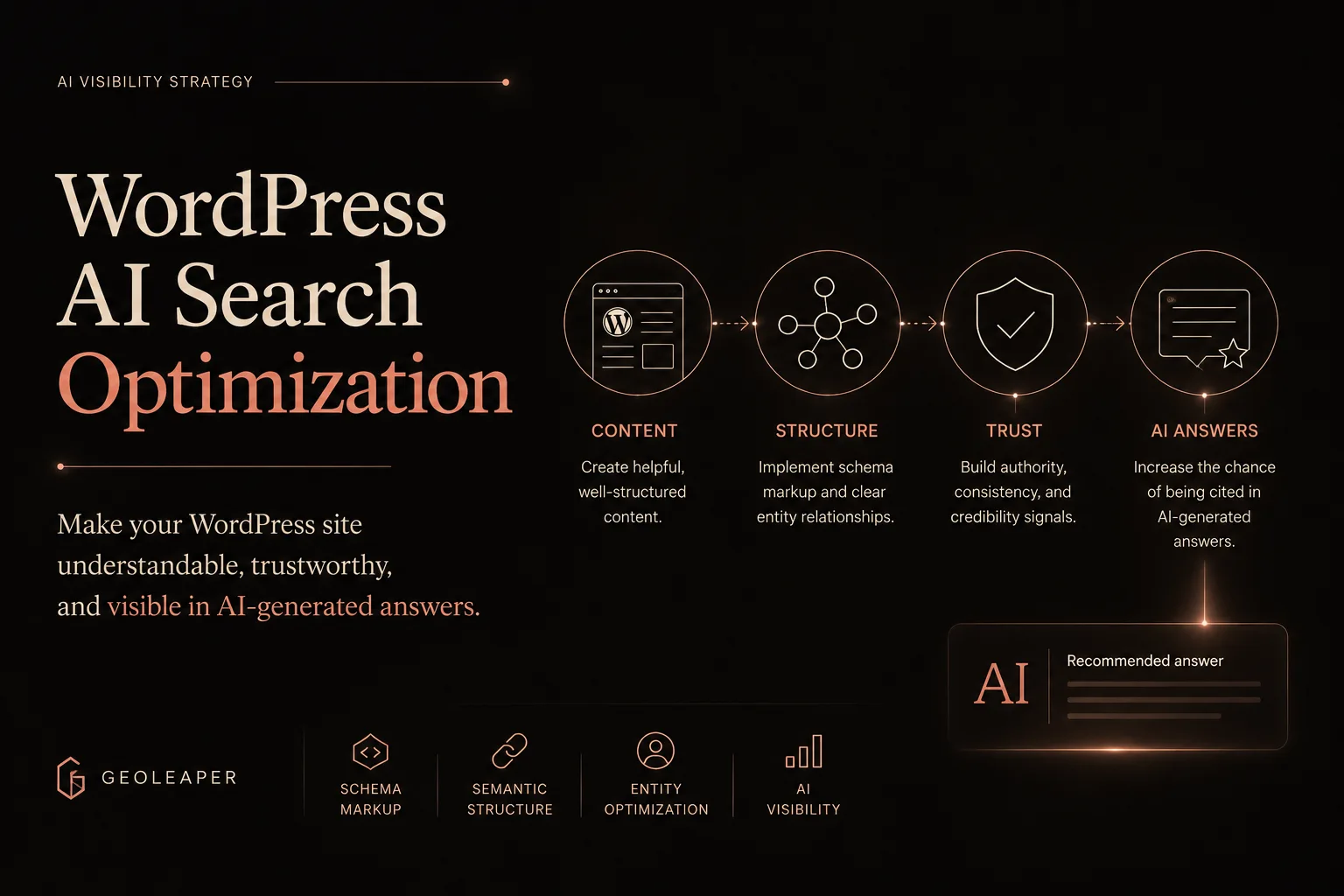
Search is changing rapidly.
Instead of only browsing traditional search engine results, users increasingly ask AI systems directly:
- Which tool should I use?
- What company is best?
- How does this work?
- What solution is recommended?
Platforms like OpenAI ChatGPT, Google Gemini, Perplexity AI Perplexity, and Microsoft Copilot are changing how websites gain visibility online.
This shift is creating a new area of optimization often referred to as AI SEO or Generative Engine Optimization (GEO).
For WordPress site owners, the question is no longer just:
“How do I rank?”
It is increasingly:
“How do I become visible inside AI-generated answers?”
What Is AI Search Optimization?
AI search optimization is the process of improving how AI systems interpret, trust, and surface your website in generated answers and recommendations.
Unlike traditional SEO, AI visibility depends heavily on:
- semantic clarity
- structured data
- entity relationships
- contextual consistency
- machine readability
- content understanding
This broader shift is explained in our guide to Generative Engine Optimization (GEO).
Traditional SEO still matters.
Backlinks still matter.
Content quality still matters.
But AI systems evaluate websites differently than classic search engines.
Why WordPress Websites Need to Adapt
Many WordPress websites were built primarily for traditional indexing systems.
That means they often contain:
- weak schema markup
- inconsistent page structures
- unclear entity relationships
- poor semantic organization
- fragmented internal context
These issues make websites harder for AI systems to interpret confidently.
As AI-generated search continues growing, websites that are easiest to understand may gain a major visibility advantage.
This is why AI search optimization is quickly becoming important for WordPress site owners, publishers, SaaS companies, ecommerce brands, and agencies.
AI Systems Need More Than Keywords
Traditional SEO often focused heavily on:
- keywords
- backlinks
- metadata
- rankings
AI systems increasingly focus on interpretation.
They attempt to understand:
- what a page represents
- how concepts connect together
- who published the content
- whether information appears trustworthy
- whether semantic signals align consistently
This is one reason many websites rank reasonably well in traditional search while remaining largely invisible in AI-generated answers.
Our article on how AI search engines understand your website explores this shift in more detail.
The Role of Schema Markup in AI Search
Structured data has become one of the most important technical layers in AI visibility.
Schema markup helps AI systems understand:
- page purpose
- products
- organizations
- authors
- services
- relationships between entities
But many websites still rely on generic schema implementations that provide limited semantic value.
Good AI visibility requires more than simply injecting templates.
It requires semantic consistency across the entire website.
This article on why schema markup matters for AI search explains why structured data quality matters more than many businesses realize.
Internal Structure Is Becoming More Important
AI systems increasingly interpret websites as connected semantic ecosystems rather than isolated pages.
That means:
- internal linking matters
- entity reinforcement matters
- topical consistency matters
- contextual relationships matter
A strong semantic structure helps AI systems understand how pages support each other.
This is why many modern optimization systems focus heavily on:
- page classification
- semantic architecture
- entity mapping
- contextual linking
Our article on The Semantic Stack explains how these layers work together.
Why AI Visibility Is Becoming a Competitive Advantage
The websites most likely to succeed in AI search environments may not simply be the ones with the largest backlink profiles.
They may increasingly be the websites AI systems can:
- understand most confidently
- interpret most clearly
- reference most safely
This creates a new competitive layer online.
Businesses that adapt early to AI visibility optimization may gain:
- stronger discoverability
- more citations
- increased trust signals
- broader semantic relevance
- higher inclusion in AI-generated answers
This is one reason the concept of AI visibility strategy is becoming increasingly important for modern websites.
How WordPress Site Owners Can Prepare
To improve AI search visibility, WordPress websites should focus on:
Strong Structured Data
Implement high-quality schema markup that accurately reflects page intent and entity relationships.
Clear Semantic Organization
Ensure pages connect logically through categories, internal links, and topical structure.
Consistent Entity Signals
Maintain clear organizational identity across pages, structured data, and content.
Machine-Readable Content
Structure pages so AI systems can interpret them reliably.
Continuous Optimization
As AI search evolves, websites must continuously improve semantic clarity and structured understanding.
This is exactly the type of analysis modern tools like the Geoleaper GEO Score Checker are designed to help identify.
The Rise of AI SEO Plugins for WordPress
A new generation of WordPress tools is now emerging specifically around AI visibility and GEO.
Unlike traditional SEO plugins focused mainly on rankings and metadata, AI search optimization platforms increasingly focus on:
- semantic clarity
- schema quality
- contextual understanding
- entity optimization
- machine readability
For example, the Geoleaper AI search WordPress plugin focuses specifically on helping websites improve AI interpretability and semantic visibility.
You can also explore the broader Geoleaper tools platform to understand how semantic optimization systems are evolving.
Final Thoughts
AI search is still in its early stages.
But the direction is becoming increasingly clear:
visibility online is moving beyond rankings alone.
The next generation of websites will likely compete not only on authority and backlinks, but also on semantic clarity, structured understanding, and AI interpretability.
For WordPress site owners, AI search optimization may soon become just as important as traditional SEO itself.