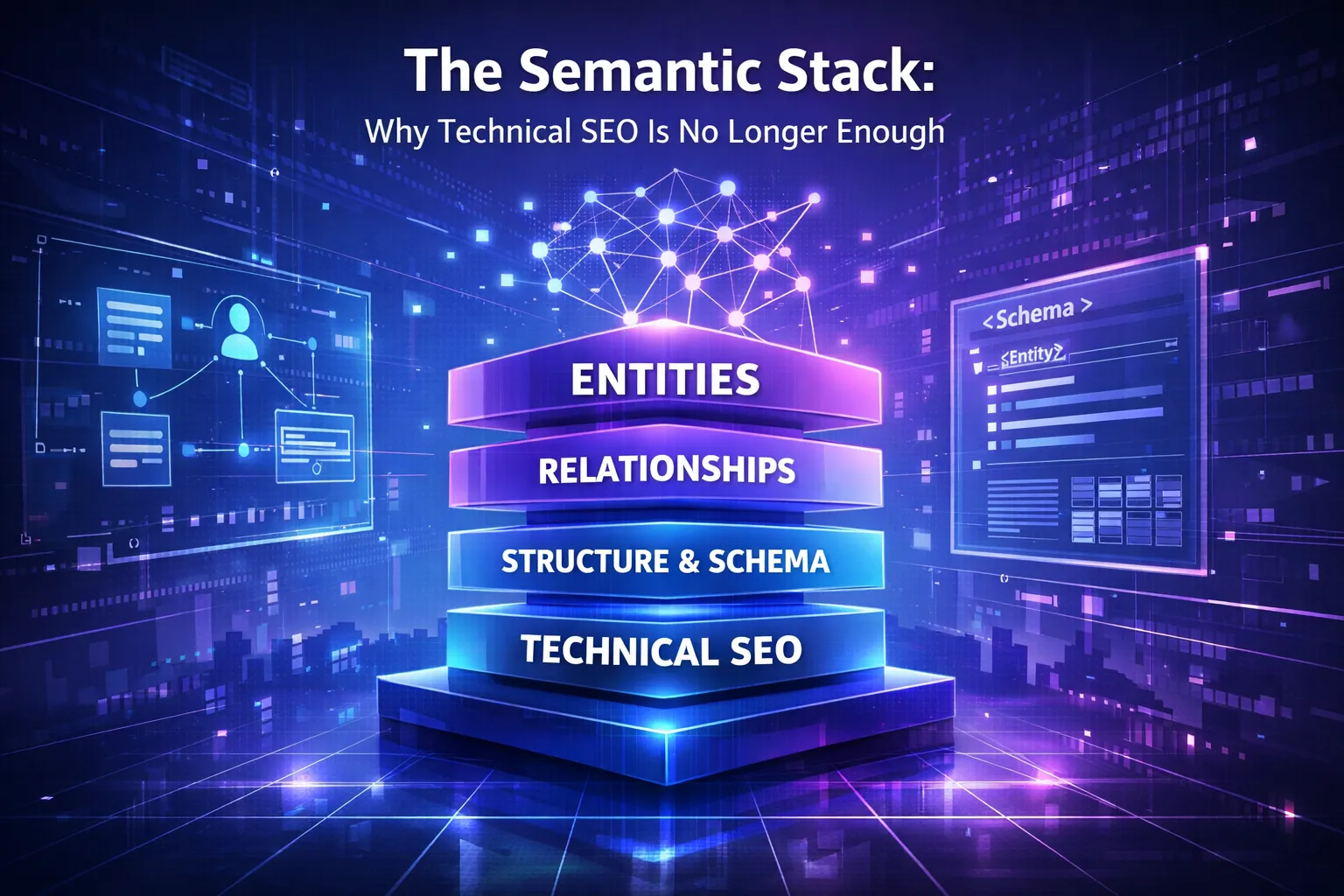
For years, technical SEO was the foundation of visibility.
Crawlability.
Indexation.
Site speed.
Structured data.
These elements still matter — but they are no longer sufficient.
In AI-driven discovery, visibility depends on something deeper: a semantic stack that makes your site understandable, explainable, and reusable.
Technical SEO Solves Access — Not Understandin
Traditional technical SEO ensures that search engines can access your content.
But access does not equal comprehension.
The shift described in From Crawl to Comprehension changed the equation. AI systems no longer simply index pages. They interpret relationships, assess intent, and evaluate structural reliability.
A technically optimized site can still fail the comprehension test.
The Limits of Optimization Without Meanin
Many teams assume that more optimization equals more visibility.
They improve:
- Core Web Vitals
- metadata
- internal linking
- schema implementation
Yet they still struggle with the AI visibility gap.
Why?
Because optimization addresses performance — not meaning.
AI systems evaluate whether a site is structurally coherent and semantically stable. If entities are fragmented or page roles unclear, technical polish cannot compensate.
What Is a Semantic Stack?
A semantic stack aligns:
- page purpose
- entity definitions
- internal relationships
- structured data
- consistent terminology
It ensures that the system can confidently answer:
- What does this site represent?
- What entities are primary?
- How do these concepts relate?
- When should this source be included?
Without this alignment, ambiguity increases — and ambiguity is interpreted as risk, as explained in How AI Decides Which Sources Are Safe to Include.
Entities Are the Core Layer
At the center of the semantic stack are entities.
AI systems reason through entities and relationships. When entity definitions shift across pages, authority fragments.
This is why entity authority increasingly outweighs domain authority (Entity Authority vs Domain Authority) and why semantic consistency compounds visibility over time.
A stable entity model reduces interpretive friction.
Structure Determines Explainability
AI systems must explain the sources they use.
They favor sites that:
- maintain clear page roles
- separate informational and transactional intent
- reinforce entity relationships
- minimize contradiction
When page types blur, the system struggles to classify purpose — a structural issue examined in The Hidden Cost of Misaligned Page Types in AI Search.
Technical SEO cannot fix structural confusion.
Schema Is a Comprehension Layer, Not a Ranking Hack
Structured data often gets treated as a checklist item.
But schema plays a deeper role: it reinforces entity definitions and clarifies intent.
When aligned with content and structure, it strengthens machine understanding — not rankings alone. This is why schema matters beyond rich results, as explored in Why Schema Markup Matters.
Without semantic alignment, schema becomes noise. The Intent Engine helps maintain this alignment automatically.
From Optimization to Alignment
The evolution from technical SEO to semantic architecture reflects a broader shift:
- From ranking to inclusion
- From authority to explainability
- From volume to clarity
As discussed in Why AI Visibility Can’t Be Fixed with Content Alone, publishing more content without structural alignment amplifies ambiguity.
Optimization scales performance.
Alignment scales trust.
The Competitive Advantage of a Semantic Stack
Websites with a coherent semantic stack are:
- easier to interpret
- easier to summarize
- easier to reuse
- easier to trust
Over time, this creates a compounding advantage similar to what early movers experience in AI-driven search, as seen in What Early Adopters Do Differently to Win AI Visibility.
Inclusion becomes predictable rather than accidental. Explore Geoleaper’s pricing plans to start building your semantic stack.
The Strategic Implication
Technical SEO remains necessary — but it is no longer the ceiling.
The ceiling is semantic coherence — the kind that Generative Engine Optimization is designed to build.
Sites that build a semantic stack — grounded in entity relationships and automated structured data — become explainable systems.
Sites that rely on technical optimization alone remain fragile in AI-driven discovery.
And in an environment where visibility depends on interpretability, fragility becomes exclusion.