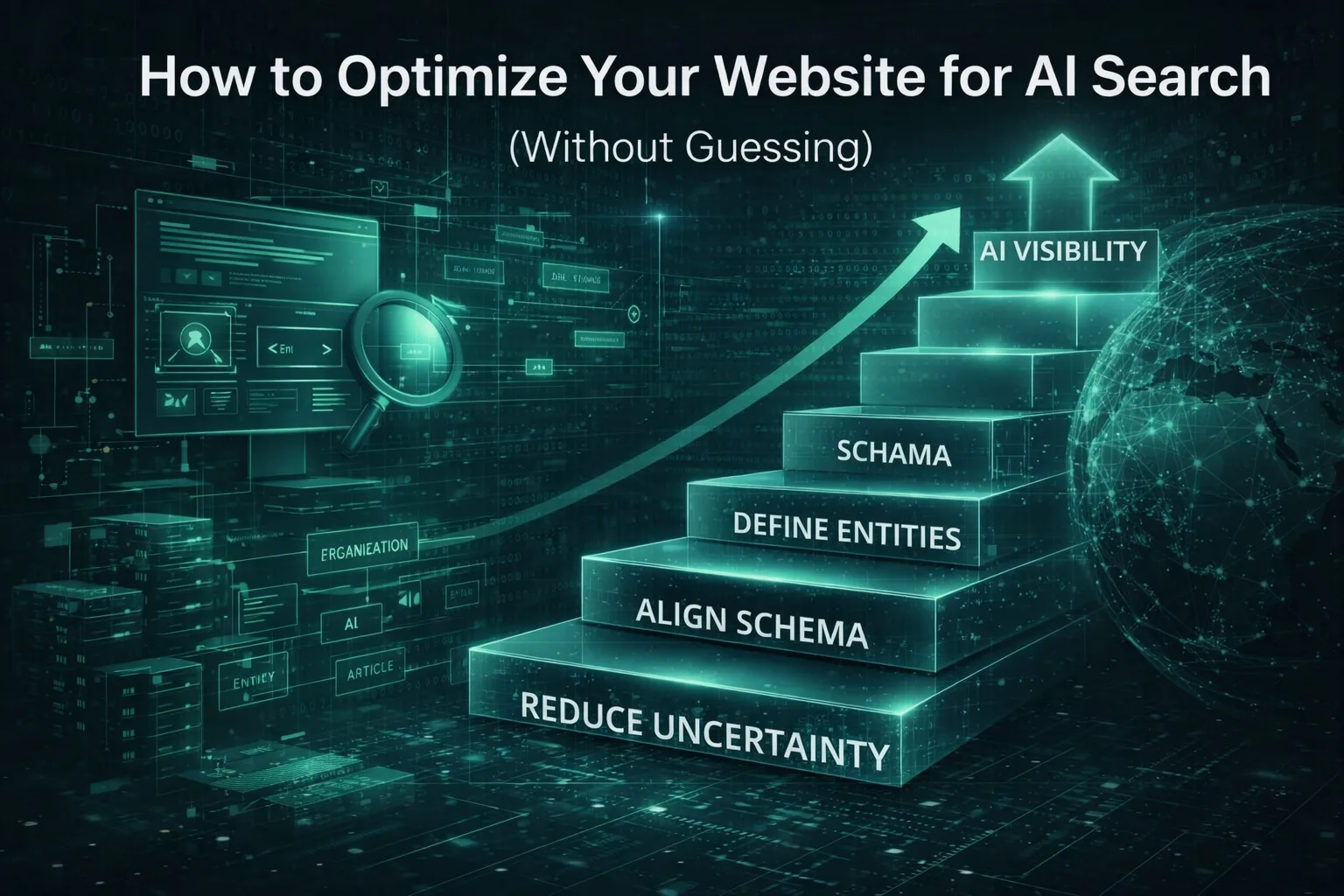
As AI-driven search becomes more dominant, a new question is emerging:
How do you actually optimize for it?
Most advice today is either speculative or recycled from traditional SEO. But AI search doesn’t work the same way — and optimizing for it requires a different approach.
AI Search Is Not Just “Better Google”
Traditional SEO is built around ranking.
AI search is built around selection and inclusion.
Instead of returning a list of links, AI systems generate answers — and choose which sources to include.
This shift, explained in From Crawl to Comprehension, changes what optimization means entirely.
Step 1: Make Your Pages Interpretable, Not Just Crawlable
Search engines used to ask: Can we access this page?
AI systems ask: Can we understand this page?
This means:
- clear page purpose
- consistent structure
- aligned content and intent
- minimal ambiguity
Without this, your content may never even be evaluated — one of the core problems behind the AI visibility gap.
Step 2: Define and Stabilize Your Core Entities
AI systems don’t rank pages — they reason about entities.
To optimize for AI search, you need to:
- define what your site represents
- keep terminology consistent
- reinforce entities across pages
- avoid redefining concepts
This is why entity authority is replacing domain authority (Entity Authority vs Domain Authority).
Step 3: Align Page Types With Intent
AI systems classify pages before they evaluate them.
If your pages mix:
- informational content
- commercial intent
- navigational structure
…classification becomes uncertain.
And uncertainty leads to exclusion.
This structural issue is explored in The Hidden Cost of Misaligned Page Types in AI Search.
Step 4: Build a Semantic Structure, Not Just Content Volume
Publishing more content does not increase visibility if structure is unclear.
AI systems favor sites that:
- maintain consistent relationships between topics
- reinforce meaning across pages
- structure content around entities
- align schema with actual page purpose
This is the foundation of a coherent semantic stack.
Step 5: Reduce Interpretive Risk
AI systems are risk-averse.
They favor sources that are:
- predictable
- consistent
- easy to explain
- structurally reliable
As outlined in Why AI Decides Which Sources Are Safe to Include, inclusion is based on reducing uncertainty — not just improving quality.
Step 6: Optimize for Reuse, Not Just Discovery
In AI search, visibility compounds.
Sources that are:
- reused
- cited repeatedly
- consistently included
…gain long-term advantage.
This is why predictability beats popularity (Why AI Search Rewards Predictability Over Popularity).
Step 7: Treat AI Optimization as a System, Not a Tactic
There is no single “AI SEO trick”.
Optimization requires alignment across:
- content
- structure
- entities
- schema
- internal linking
As explained in Why AI Visibility Can’t Be Fixed with Content Alone, isolated improvements rarely work.
The Real Shift
Optimizing for AI search is not about chasing rankings.
It’s about becoming:
- understandable
- explainable
- reusable
- trustworthy
Sites that achieve this don’t just appear — they persist.