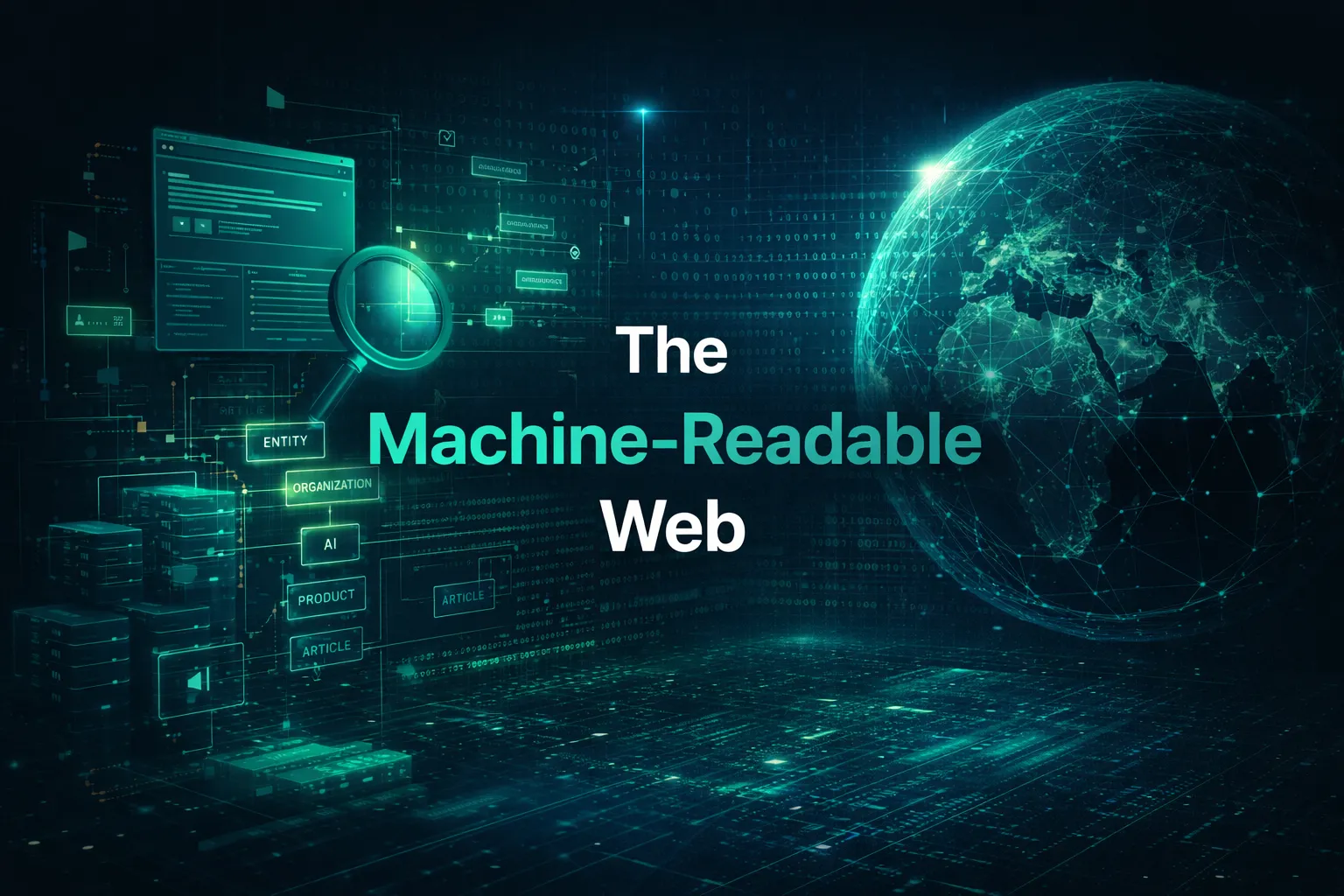
For most of the history of search engines, visibility online was primarily about retrieval. Websites created pages, search engines crawled them, and algorithms ranked them based on relevance and authority.
This model defined search for more than two decades.
But artificial intelligence is beginning to change how the web is interpreted.
Modern AI systems such as ChatGPT, Claude, and Perplexity are not simply retrieving pages from an index. Instead, they analyze large volumes of information and generate answers based on what they understand.
That shift marks a fundamental change in how visibility on the internet works.
Instead of ranking links, AI systems decide which sources they can interpret, trust, and explain.
From Crawlability to Comprehension
Traditional SEO focused heavily on technical accessibility. If search engines could crawl a page, index it, and understand its keywords, the page had a chance to rank.
But AI-driven systems operate at a different layer.
They attempt to interpret the meaning of content and how it connects to other concepts across the web.
In other words, the web is shifting from being crawlable to being comprehensible.
For a website to become visible in AI-driven discovery systems, it must communicate meaning clearly enough for machines to interpret.
This is where the concept of Generative Engine Optimization becomes increasingly important.
Rather than focusing only on rankings, this approach focuses on structuring websites so that AI systems can understand entities, relationships, and context across the entire site.
Why AI Systems Need Context
Large language models are extremely capable at processing natural language, but they still rely heavily on context signals.
When an AI system analyzes a web page, it attempts to determine:
- what entities the page describes
- how those entities relate to other concepts
- whether the information appears reliable
- how the page fits into the broader knowledge graph of the web
If those signals are unclear, the system may struggle to interpret the page confidently.
Even well-written content can become difficult for machines to understand when its structure is ambiguous.
For example, a page might discuss a technology concept, a company, and a product category.
But unless those relationships are clearly defined, machines must infer the connections.
And when machines have to guess, they often choose safer sources instead.
The Importance of Entity Clarity
One of the biggest shifts in modern search is the growing importance of entities.
Entities represent identifiable concepts such as organizations, products, technologies, and people. Instead of relying purely on keywords, AI systems increasingly map information through relationships between entities.
This shift means that visibility online depends less on isolated pages and more on coherent semantic structures.
A website that clearly defines its entities and connects them logically across pages provides stronger signals for AI interpretation.
This is why strategies like Entity SEO in the Age of AI — Why Connections Matter More Than Keywords are becoming increasingly important for modern websites.
By structuring relationships between topics and entities, websites help machines understand not only what their pages say, but what they actually mean.
Structured Data as the Language of Machines
Another essential component of machine-interpretable websites is structured data.
Structured data provides a standardized format that helps machines interpret content more precisely.
Using schema markup, websites can explicitly describe elements such as:
- organizations
- products
- articles
- software applications
- relationships between entities
This allows machines to move beyond guesswork and interpret the structure of information more accurately.
The importance of this layer is explored in detail in What Schema Markup Really Means — and Why Getting It Right Matters More Than Ever, which explains why structured data is increasingly critical for AI-driven discovery systems.
Without these signals, even high-quality websites may struggle to communicate their meaning effectively to machines.
Why Structure Beats Volume
Many websites still attempt to improve visibility by simply publishing more content.
While content volume can increase topical coverage, it does not automatically improve AI visibility.
In fact, publishing large amounts of content without a clear semantic structure can create confusion for machines.
AI systems prioritize clarity.
A smaller website with a clear structure, well-defined entities, and consistent relationships between pages may be easier for machines to interpret than a much larger site with fragmented signals.
This is why the next generation of search optimization focuses less on content quantity and more on semantic coherence.
The Web Is Becoming a Knowledge Graph
As AI systems evolve, the internet increasingly resembles a distributed knowledge graph rather than a simple collection of pages.
Each website contributes nodes and relationships to that graph.
Pages define entities.
Links connect concepts.
Structured data clarifies relationships.
When these signals align, machines can interpret information with greater confidence.
This shift is transforming how visibility works online.
Instead of simply ranking pages based on keyword relevance, AI systems are evaluating how well information fits into a broader network of knowledge.
Preparing Websites for the AI-Driven Web
The transition toward AI-driven discovery does not eliminate traditional SEO practices.
Content quality, authority signals, and technical performance will remain important.
However, websites must now add another layer of optimization: machine interpretability.
This involves:
- defining entities clearly
- connecting topics across pages
- implementing consistent structured data
- ensuring each page has a clear semantic role
When these elements work together — supported by tools like the Intent Engine — websites become easier for machines to interpret and trust.
And in a world where AI systems increasingly act as the gateway to information, the websites that machines understand best will likely be the ones that remain visible. Even brilliant content can stop at 98/100 without proper machine-readability.