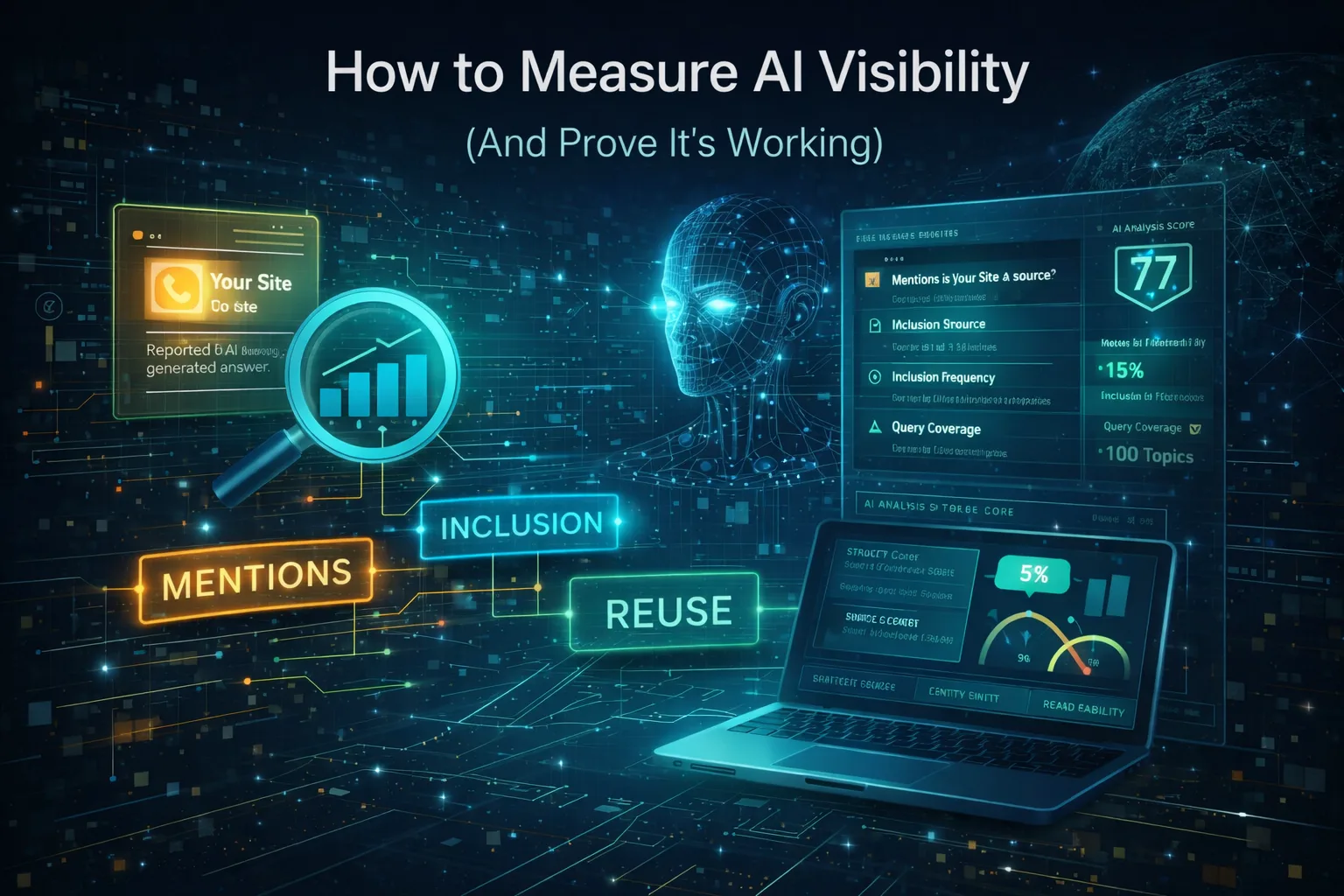
AI visibility is becoming a priority.
But there’s a problem:
Most teams have no idea how to measure it.
If AI systems don’t send traditional traffic the same way search engines do, how do you know if your site is actually being used?
AI Visibility Is Not Measured Like Traditional SEO
In traditional SEO, success is easy to track:
- rankings
- clicks
- impressions
AI search breaks this model.
AI systems:
- don’t always show links
- don’t always send traffic
- don’t expose clear attribution
This shift is a direct consequence of moving from crawl to comprehension.
The Wrong Way to Measure AI Visibility
Most teams try to use:
- Google Search Console
- organic traffic
- keyword rankings
But these only measure search engine visibility, not AI inclusion.
This is why many sites think they’re performing well — while still suffering from the AI visibility gap.
What AI Visibility Actually Looks Like
AI visibility is about:
- being mentioned in generated answers
- being used as a source
- being repeatedly referenced
- shaping outputs, even without clicks
This is part of the shift toward the AI citation economy.
The Core Metrics That Matter
To measure AI visibility, you need to track:
1. Mentions in AI Outputs
Are you being referenced in answers?
2. Inclusion Frequency
How often does your content appear across prompts?
3. Query Coverage
Across how many topics are you included?
4. Consistency Over Time
Are you appearing repeatedly or randomly?
5. Brand Recall
Are users exposed to your brand in AI answers?
Why Visibility Without Clicks Still Matters
AI changes behavior.
Users may:
- get answers without clicking
- make decisions immediately
- never visit your site
But your brand still influences the outcome.
This is why visibility connects directly to business outcomes, as shown in How GEO Improves Conversions and Builds Brand Trust.
The Real Signal: Reuse
The strongest signal is not a single mention.
It’s reuse.
When AI systems:
- repeatedly include your site
- across different prompts
- over time
…it means your content is considered safe and reliable
This behavior is tied to how systems select sources, as explained in How AI Decides Which Sources Are Safe to Include.
Why Most Sites Fail to Measure This
Because they focus on:
- traffic
- rankings
- keywords
Instead of:
- structure
- entities
- consistency
- inclusion
As explained in Why AI Visibility Can’t Be Fixed with Content Alone, traditional metrics don’t capture AI behavior.
How to Actually Track AI Visibility
There are three practical approaches:
1. Manual Prompt Testing
- run consistent queries
- track if your brand appears
- repeat over time
2. AI Mention Tracking
- monitor references across models
- compare competitors
3. Structural Scoring
- evaluate how understandable your site is
- measure entity clarity
- identify gaps
This is where structured analysis becomes critical.
The Strategic Shift
You’re no longer optimizing for:
- rankings
- clicks
You’re optimizing for:
- inclusion
- reuse
- trust
And that requires new ways of measuring success.
The Bottom Line
If you can’t measure AI visibility, you can’t improve it.
And if you rely on traditional metrics, you’ll think you’re performing well — while remaining invisible where it matters most.