
In traditional search, visibility fluctuates.
Rankings move.
Competitors enter.
Traffic shifts.
In AI-driven discovery, visibility behaves differently.
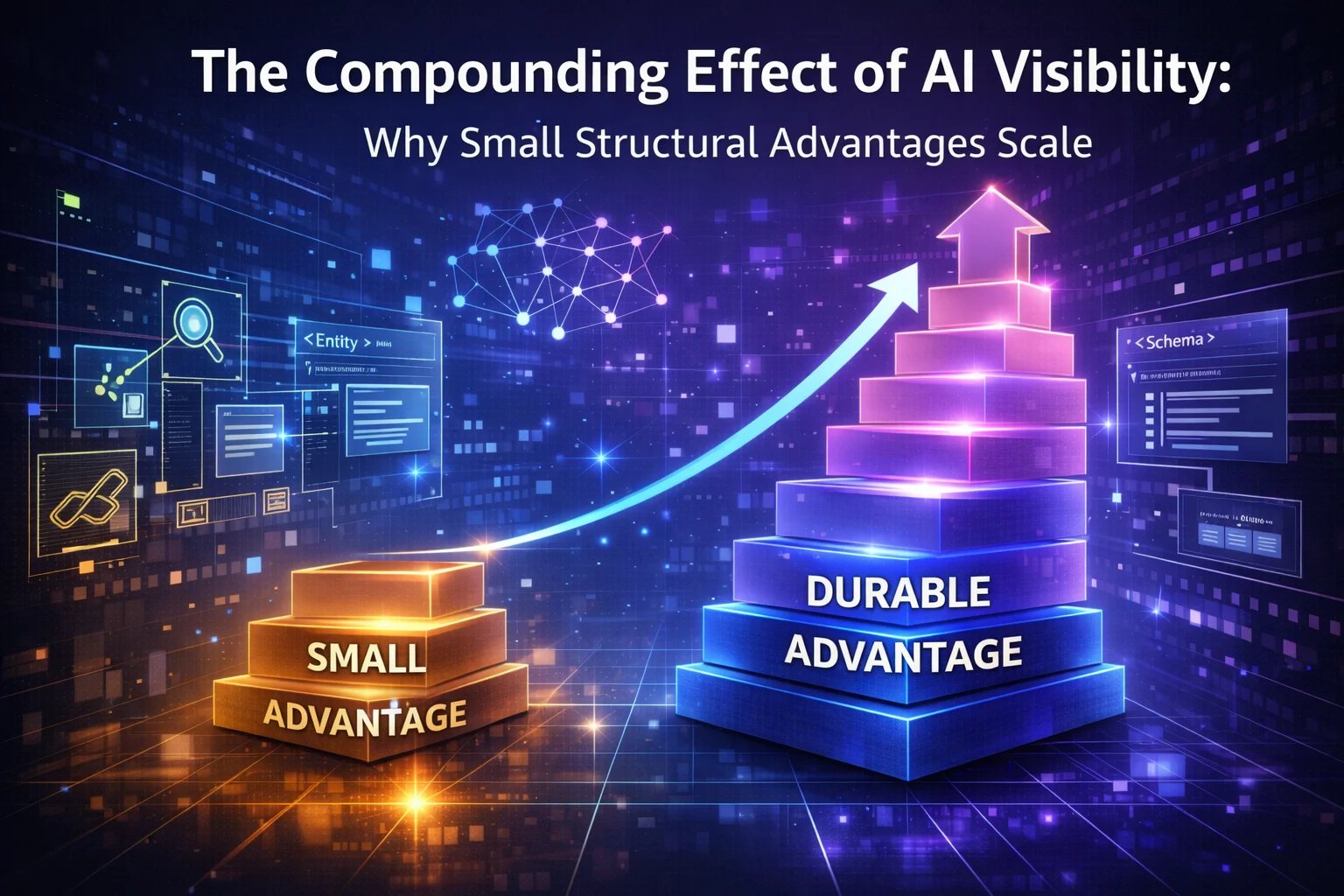
Small structural advantages don’t just improve outcomes — they compound.
Inclusion Is Reused, Not Recalculated From Scratch
Generative AI systems do not treat every query as a blank slate.
When a source has been included safely before, it becomes easier to include again. This creates a feedback loop where structural clarity increases the probability of repeated inclusion.
This dynamic helps explain the persistence described in the AI visibility gap, where some brands consistently appear while others rarely surface.
Visibility compounds through reuse.
Structural Trust Reduces Friction Over Time
AI systems optimize for efficiency and risk reduction.
When a source is:
- structurally predictable
- semantically consistent
- aligned in page intent
- reinforced through stable entities
…the system builds confidence.
This mirrors the shift outlined in From Crawl to Comprehension, where interpretability replaces simple indexation.
Each successful inclusion lowers future friction.
Fragmentation Prevents Compounding
Many organizations unknowingly prevent compounding by:
- redefining entities across pages
- blending informational and commercial intent
- introducing inconsistent terminology
- publishing disconnected topic clusters
These patterns increase interpretive cost.
As explained in The Hidden Cost of Misaligned Page Types in AI Search, structural ambiguity slows or blocks inclusion.
In AI search, inconsistency resets trust.
Entity Stability Drives Momentum
Compounding visibility is rooted in entity stability.
When core entities are:
- clearly defined
- reused consistently
- supported by aligned schema
- embedded in stable relationships
…the system strengthens its internal model.
This is why entity authority increasingly outweighs domain authority (Entity Authority vs Domain Authority) and why semantic coherence forms the foundation of a strong semantic stack.
Stability accumulates.
Early Structural Advantages Become Durable Advantages
Early adopters of AI visibility often appear disproportionately in answers.
This is not necessarily due to volume or popularity. It is often due to:
- clear page roles
- predictable entity models
- low interpretive ambiguity
- aligned structure across content
As observed in What Early Adopters Do Differently to Win AI Visibility, structural alignment enables momentum.
Inclusion becomes habit-forming.
Compounding Is Strategic, Not Accidental
Small improvements in:
- page clarity
- entity consistency
- schema alignment
- internal hierarchy
…may appear incremental.
But in AI-driven systems, incremental clarity compounds into durable inclusion.
As discussed in The Silent Risk of AI Visibility, ignoring structural clarity is not neutral. It allows competitors’ advantages to compound instead.
Visibility is path-dependent.
The Strategic Implication
AI visibility is not won through sudden spikes.
It is built through accumulated structural reliability.
Organizations that treat AI readiness as a system — rather than a campaign — create compounding advantages that are difficult to replicate.
Over time, the gap between structurally coherent and structurally fragmented sites widens.
And in AI-driven discovery, widening gaps become durable hierarchies.