TL;DR
-
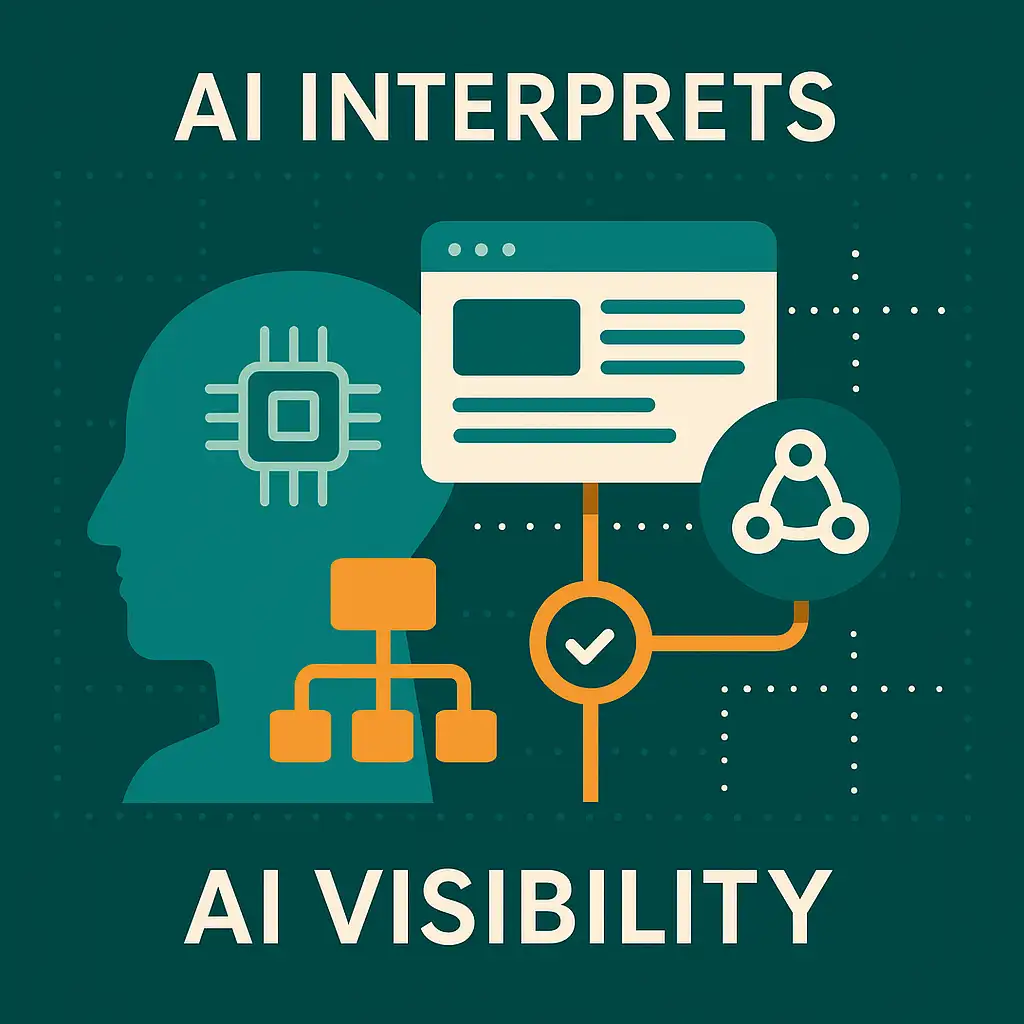
AI doesn’t crawl — it interprets. Generative engines rely on entity clarity and structured meaning, not traditional SEO signals.
-
Most websites are invisible to AI. Missing, incorrect, or outdated schema makes content unusable for LLMs.
-
Entity authority beats domain authority. AI chooses sources it can understand and verify — not sites with the most backlinks.
-
AI visibility is binary. You’re either included in the answer or completely excluded. There is no “page 2.”
-
Automation is the only path forward. Maintaining machine-readable structured data manually is impossible at scale — GEO solves this gap.
The biggest shift in online visibility since the birth of Google is happening right now — quietly, rapidly, and mostly unnoticed by the people who should notice it first.
For two decades, websites were built for human readers and for search crawlers. But generative AI engines do not crawl, index, or rank in the way we’re used to. They interpret, reason, and assemble answers. They don’t look for keywords. They look for entities. They don’t measure Domain Authority. They measure trustability, consistency, and completeness of structured meaning.
And today, most of the web simply doesn’t meet that standard.
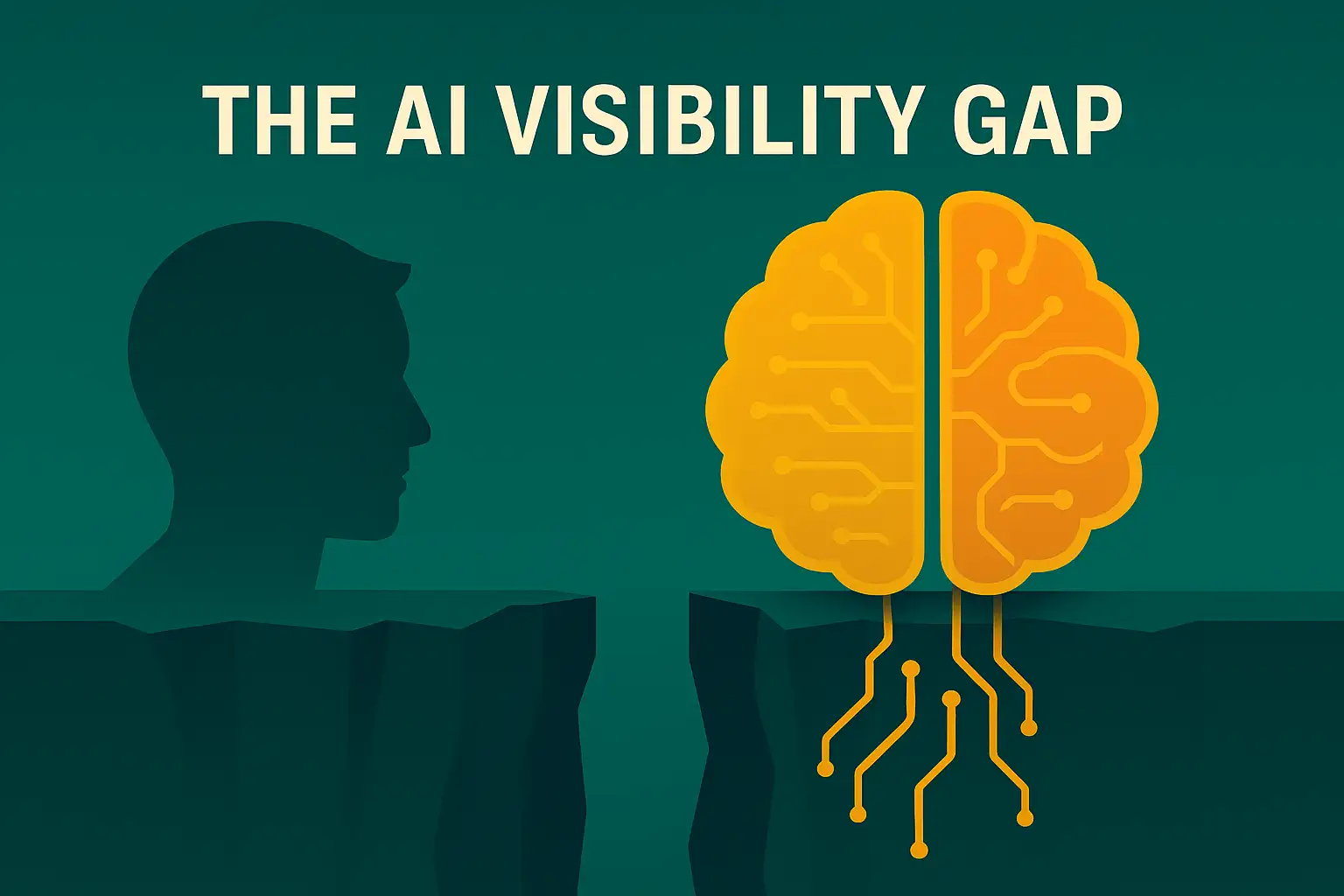
This is what we call the AI Visibility Gap — the widening divide between websites humans can read and websites AI models can use.
It is already reshaping the competitive landscape. And only a small percentage of companies understand how quickly this transition is happening.
AI Search Has a Different Input Layer — and Most Sites Aren’t Built for It
Traditional search engines extract signals from HTML, metadata, links, layout, authority metrics, and user behavior patterns.
Generative AI systems extract meaning from:
-
structured data (JSON-LD, microdata, RDFa)
-
entity definitions (Organization, Person, Product, Article, Service, FAQ)
-
semantic alignment across a site
-
data consistency across external sources
-
verifiability through authoritative IDs
-
content clarity and topical density
This is a fundamentally different model.
Google rewarded signals.
AI rewards structure and certainty.
A webpage that ranks #1 on Google can still be invisible to ChatGPT or Claude if:
-
schema markup is missing
-
entities are undefined
-
relationships aren’t declared
-
names vary across pages
-
external references aren’t linked
-
content contradicts metadata
-
or the structured layer is incomplete, outdated, or low-quality
It’s not that AI can’t read the page.
It’s that the page has no machine-grounded definition.
Why 90% of Websites Fail AI Interpretability
We’ve now run hundreds of early GEO tests internally, and the pattern is universal:
Most websites are written for humans.
Almost none are written for machines.
Here’s what we consistently see:
Incomplete or outdated schema
Article pages missing author / datePublished
Products missing brand / GTIN / offers
Organizations missing sameAs
FAQs missing acceptedAnswer
Wrong schema type entirely
A blog post marked as a WebPage
A category page marked as a Product
A homepage marked as an Article
(Google may tolerate this. AI engines will not.)
No identity layer
No About page entity
No Organization schema
No consistency between HTML + JSON-LD
No external verification links
Zero entity disambiguation
An AI model cannot confidently determine what the page represents.
When a model can’t identify an entity, it can’t use it in an answer.
When it can’t use it in an answer, visibility drops to zero.
This is the AI Visibility Gap in practice.
Generative Engines Do Not “Rank” — They Choose Sources
When you ask:
-
“What is GEO?”
-
“Best CBD shops in Stockholm?”
-
“How to fix Article schema errors?”
-
“Top WordPress SEO tools in 2025?”
…AI models don’t go through pages ranked by authority.
Instead, they do three things:
-
Identify entities relevant to the question
-
Evaluate which ones are trustworthy
-
Assemble an answer from those entities
This is why a tiny site with perfect structured data can appear —
while a giant website without it does not.
AI favors clarity, not legacy.
AI Visibility Is Not Just About Being Indexed — It’s About Being Understandable
This is the key shift investors and founders need to understand:
The future of visibility is not “Can Google see you?”
It’s “Can AI understand you?”
A website with high human readability but poor machine readability has:
-
high SEO traffic today
-
low AI visibility tomorrow
This is the quiet trap most companies are falling into.
For AI engines, visibility isn’t based on domain strength —
it’s based on machine certainty.
Google indexes documents.
AI engines build knowledge graphs.
The point of failure (or success) is now the structured layer.
Structured Data Isn’t Optional Anymore — It’s Infrastructure
A decade ago, schema markup was a “nice-to-have” for rich snippets.
Today, it is infrastructure for AI search.
If your structured layer is wrong:
-
AI models can’t establish what your page is
-
They can’t link your entity to external knowledge
-
They can’t verify factual alignment
-
They can’t use your data
-
They can’t cite your site
-
And they won’t mention your brand in answers
It’s not a ranking problem. It’s an interpretation problem. And generative engines drop unclear entities instantly.
Structured Data Isn’t Optional Anymore — It’s Infrastructure
A decade ago, schema markup was a “nice-to-have” for rich snippets.
Today, it is infrastructure for AI search.
If your structured layer is wrong:
-
AI models can’t establish what your page is
-
They can’t link your entity to external knowledge
-
They can’t verify factual alignment
-
They can’t use your data
-
They can’t cite your site
-
And they won’t mention your brand in answers
It’s not a ranking problem.
It’s an interpretation problem.
And generative engines drop unclear entities instantly.
Why This Problem Is Getting Worse — Fast
Three trends are converging:
AI engines are accelerating adoption
Perplexity, OpenAI Search, Claude’s research mode, Mistral’s assistant, and even Google’s AI Overviews all rely heavily on structured meaning.
Most websites change content faster than schema
Especially ecommerce, SaaS, news, and marketplaces.
Every content update requires a schema update.
Nobody does this manually.
Frameworks, plugins, and CMS tools are outdated
They assume SEO-era requirements, not AI-era requirements.
The gap widens daily.
The Winner-Take-Most Dynamics of AI Visibility
Here is the important part:
In AI engines, visibility is not linear — it is binary.
You are either:
-
included in the answer
-
or excluded entirely
There is no Page 2.
No “slightly lower ranking”.
No long-tail distribution.
This creates winner-take-most dynamics where a few well-structured entities dominate.
The moment an AI system identifies an entity as trustworthy, it becomes a default building block in answers across millions of queries.
This is why early movers will gain disproportionate advantage.
The Opportunity for Builders and Investors
This shift isn’t a small optimization trend.
It’s a foundational change in how the web interfaces with intelligence systems.
Structured data is becoming:
-
the identity layer
-
the trust layer
-
the retrieval layer
-
the connection layer
-
the visibility layer
Companies that master this win the AI visibility war.
Companies that ignore it become invisible — regardless of SEO history, DA, or backlink profile.
This is why we built Geoleaper.
Because the gap is massive.
The need is universal.
And the solution must be automated.
Why Automation Is the Only Sustainable Path Forward
Doing structured data manually:
-
takes 50–200 hours per site
-
breaks with every update
-
requires deep schema knowledge
-
is impossible at scale
-
is far too error-prone for AI engines
-
and is not how the future works
The companies who win AI visibility will be the ones who:
-
update schema every time content changes
-
keep entity definitions consistent site-wide
-
maintain complete structured data for every page type
-
enforce alignment between HTML and JSON-LD
-
and scale all of this automatically
This is the layer Geoleaper is building.
A fully automated structured data engine that:
-
analyzes your site
-
identifies gaps
-
writes and updates schema markup
-
enforces consistency
-
and maintains machine readability over time
No guesswork.
No manual fixes.
No invisible pages.
Conclusion: The AI Visibility Gap Is the Next Great Migration
Just like companies had to:
-
become mobile-friendly
-
adopt HTTPS
-
optimize for Core Web Vitals
-
and embrace responsive design
…they now need to become AI-readable.
The companies who adapt will dominate visibility across all AI interfaces.
Those who don’t will quietly disappear from the answers users see.
We built Geoleaper for one reason:
To close the AI Visibility Gap — automatically, intelligently, and at scale.
And based on the conversations we’re having,
the market is starting to understand just how big this shift truly is.