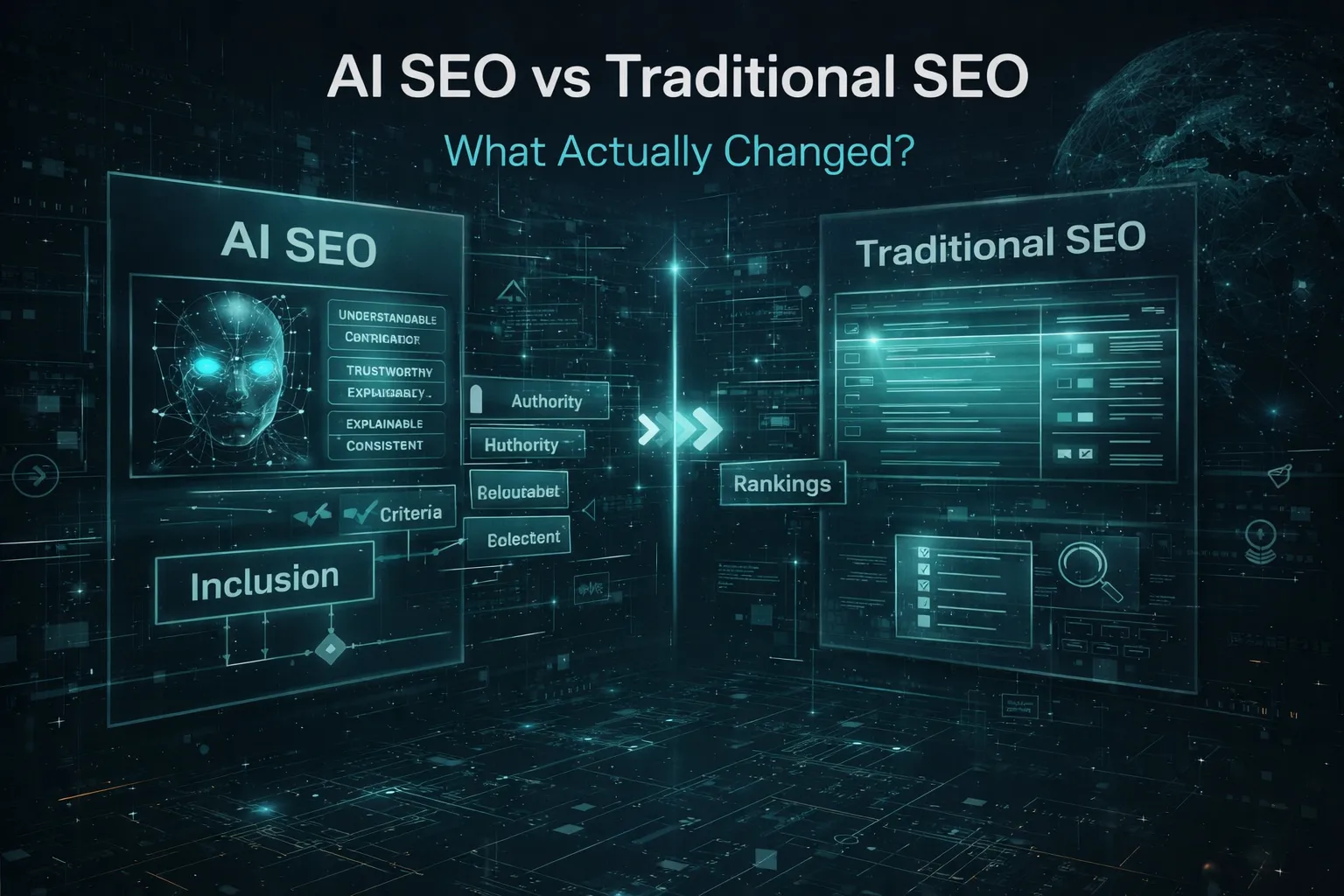
For years, SEO followed a relatively stable model.
You optimized pages.
Search engines ranked them.
Users clicked links.
That model is now breaking.
AI-driven search doesn’t just change how results are displayed — it fundamentally changes how visibility is earned.
Traditional SEO Was Built on Ranking
In traditional search:
- pages compete for rankings
- authority is inferred through backlinks
- relevance is based on keywords
- success is measured in clicks
The system returns a list.
Users choose what to click.
This model rewards optimization for position.
AI SEO Is Built on Inclusion
AI search works differently.
Instead of ranking pages, systems generate answers and select sources to include.
This shift, explained in From Crawl to Comprehension, means visibility depends on whether your content is:
- understandable
- trustworthy
- easy to explain
- structurally consistent
If your content isn’t selected, it doesn’t matter how well it ranks.
Ranking vs Selection: The Core Difference
The biggest shift is this:
- Traditional SEO → Where do you rank?
- AI SEO → Are you included at all?
This is the core driver behind the AI visibility gap, where strong sites disappear simply because they are not selected.
In AI search, visibility is binary: included or not.
Keywords vs Meaning
Traditional SEO relies heavily on keywords.
AI systems rely on meaning.
They interpret:
- entities
- relationships
- context
- intent
This is why entity authority is replacing domain authority (Entity Authority vs Domain Authority) and why semantic clarity matters more than keyword density.
Content vs Structure
In traditional SEO, better content often leads to better rankings.
In AI search, content alone is not enough.
AI systems evaluate whether your site is:
- structurally coherent
- consistent across pages
- aligned in intent
- semantically stable
As outlined in Why AI Visibility Can’t Be Fixed with Content Alone, publishing more content without fixing structure increases ambiguity.
Authority vs Explainability
Traditional SEO rewards authority signals:
- backlinks
- domain strength
- brand recognition
AI systems reward explainability.
They favor sources that are:
- easy to summarize
- consistent in terminology
- predictable in structure
This is why clarity often beats sophistication, as explored in From Authority to Explainability.
Popularity vs Predictability
Popularity still matters — but less than before.
AI systems prioritize sources that are:
- stable
- consistent
- low-risk
This is why predictability beats popularity (Why AI Search Rewards Predictability Over Popularity).
A predictable source is easier to reuse.
Traffic vs Presence
Traditional SEO measures success in clicks.
AI search introduces a new metric: presence in answers.
Users may never click your site — but your brand can still:
- influence decisions
- shape perception
- drive conversions
This shift connects directly to how GEO impacts conversions and trust.
Optimization vs System Design
Traditional SEO focuses on optimizing individual pages.
AI SEO requires system-level alignment:
- entities
- structure
- schema
- internal relationships
This is the foundation of a coherent semantic stack.
You are no longer optimizing pages.
You are designing a system.
The Strategic Implication
This is not a small evolution.
It is a shift from:
- ranking → inclusion
- authority → explainability
- keywords → meaning
- content → structure
Organizations that continue optimizing for rankings alone will increasingly lose visibility.
Those that build for AI comprehension will become part of the answer.