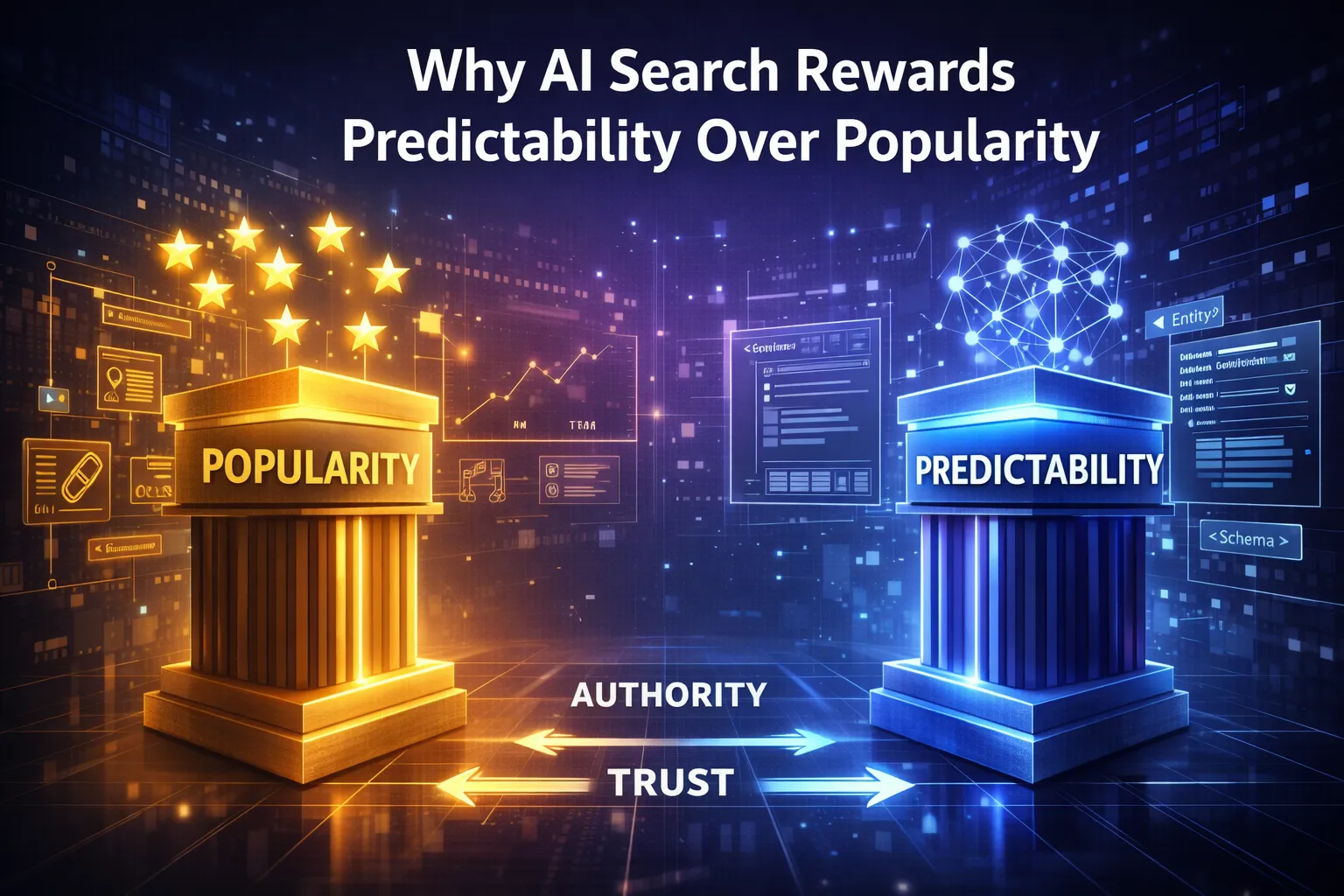
In traditional search, popularity was a proxy for authority.
Backlinks.
Brand mentions.
Traffic volume.
In AI-driven discovery, popularity still matters — but it is no longer decisive.
AI systems increasingly reward something else: predictability.
Popularity Is a Signal. Predictability Is a Safeguard.
Generative AI systems assemble answers probabilistically. Every included source must reduce uncertainty.
Popularity can suggest trust.
Predictability reduces risk.
A popular site with inconsistent structure introduces ambiguity. A predictable site with stable definitions is easier to include repeatedly.
This is one of the structural drivers behind the AI visibility gap.
AI Systems Optimize for Reusability
AI answers are generated continuously.
Systems favor sources that can be reused across contexts.
Reusable sources typically have:
- stable terminology
- clear entity definitions
- consistent page roles
- aligned structure and schema
This is part of the broader shift from crawl to comprehension, where meaning, not metadata alone, determines visibility.
Unpredictable sources increase interpretive friction.
Inconsistency Creates Risk
Many sites unintentionally reduce predictability by:
- redefining entities across articles
- mixing informational and transactional intent
- shifting tone and terminology
- embedding conflicting structural signals
From a human perspective, this feels dynamic.
From an AI perspective, it introduces risk.
As explored in The Hidden Cost of Misaligned Page Types in AI Search, unclear page roles make classification harder — and harder classification leads to exclusion.
Popularity Without Structure Is Fragile
A site may have:
- strong backlink profiles
- high brand recognition
- consistent traffic
Yet still struggle with AI inclusion.
Why?
Because authority without structural clarity does not guarantee explainability. AI systems prefer sources they can confidently justify, as discussed in Why AI Decides Which Sources Are Safe to Include.
Predictability strengthens that justification.
Entities Create Stability
Predictability begins at the entity level.
When entities are:
- consistently defined
- used in stable relational contexts
- reinforced with aligned structured data
…the system can build confidence over time.
This is why entity authority increasingly outweighs domain authority (Entity Authority vs Domain Authority) and why semantic alignment forms the foundation of a coherent semantic stack.
Stability compounds. Popularity fluctuates.
Why Early Movers Appear Everywhere
Some brands appear repeatedly in AI answers across queries.
This is rarely accidental.
They tend to:
- separate intent cleanly
- reinforce entity relationships
- minimize ambiguity
- maintain structural consistency
As noted in What Early Adopters Do Differently to Win AI Visibility, predictability allows AI systems to reuse sources with increasing confidence.
Inclusion becomes habitual.
The Strategic Implication
In AI-driven search, visibility does not belong to the loudest brand.
It belongs to the most structurally reliable one.
Popularity may open the door — but as we explore in how AI decides which sources are safe, it’s predictability that keeps it open.
Predictability keeps it open.
Organizations that prioritize semantic stability, entity consistency, and structural clarity build systems that AI can trust repeatedly.
And in a discovery environment driven by interpretation rather than ranking, repeated trust determines long-term visibility.